In Stephanie Ericsson's essay, "The ways we lie", she starts it off by saying how she lied to the bank tellers that she sent a check in the mail when she clearly didn't. To me, I think that this was an example of a little white lie. This is because her lie wasn't harming anyone, it was just to avoid fees from the bank. A white lie is one of the ten different lies she mentions. They are the white lie, facades, Ignoring the Plain Facts, Deflecting, Omission, Steroetypes and Cliches, Groupthink, Out-and-Out Lies, Dimissal, and lastly Delusion. I honestly didn't even know that there were so many different forms of lies.
For every single category, Ericsson includes several examples. I think her using the example were the most important part of her explanations. For example, I had no idea what an out-and-out lies was but then she mentioned the incident with her five year old nephew which made it a lot more clearer. However, for some of the different categories like Groupthink, it was quite confusing and didn't make any sense. Her example of it also wasn't that helpful.
I think that Ericsson wrote an essay about different types of lying because it's such a common thing to do. We lie all the time and sometimes we don't even realize it. Also I think that most of us don't even know that there are other forms of lying, including myself until now. Ericsson may have wanted to bring to light that there are several methods of lying people use. I really liked how she started her essay by listing all the lies she told in such a short span of time. This was most likely because she's no stranger to telling lies and that sometimes people lie for a reason. Like when her partner asked her how her day was, she said fine so that her partner doesn't have to worry about her problems.
Tuesday, October 22, 2013

Sunday, October 20, 2013
A skunk in a bottle?
In Robert Conners' essay, "How in the World Do You Get a Skunk Out of a Bottle?," he has quite an interesting title. I think he specifically named it this and in form of a question because throughout his whole essay, he was literally struggling to get a skunk out of a bottle. He tried several methods and they just weren't working. So obviously he just had no clue how in the world to get a skunk out of a bottle. Also, how often would a skunk really get stuck in a bottle? Not so frequently. So basically if someone were to read the title of this essay somewhere, they would immediately become curious and check it out. The title was a really good way to attract more audiences.
The situation that Robert Conners encountered is such a rare occurrence. He probably wrote about this event in the form of a process analysis because he wanted to show every single thing that happened ever since he noticed the skunk. He described how the skunk was getting suffocated and taking long slow breaths and also how he was panting back and forth on how to help the poor skunk. Innocent animals are always getting into accidents because of litter and garbage thrown away. The skunk was just an example of one that fortunately was saved because of Conners, but some aren't as lucky.
I think the main purpose of his essay was to show how animals are sometimes suffering because of us humans carelessly littering. We need to be more cautious of our actions because what we do can harm defenseless animals. So when we see a poor animal stuck in something, we shouldn't just watch but rather help if we can or ask someone else. When Conners finally got the bottle off of the skunk, they looked at each other before separating ways. It's as if the skunk was shocked that a human actually helped him. I felt like it was a very touchy moment.
Monday, October 14, 2013
False Advertising
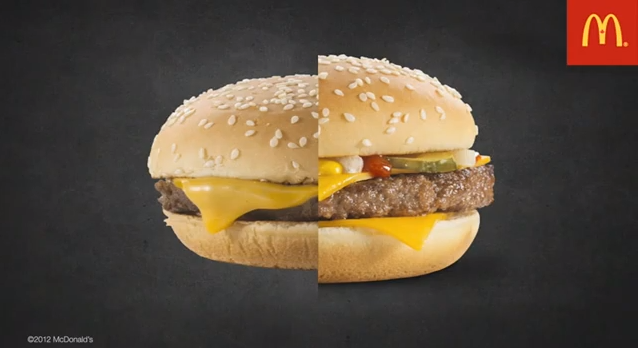 |
As consumers, we tend to buy things that appeal to the eye, meaning if something looks good or at least attractive we are more likely to purchase it. Mcdonalds definitely tries to manipulate their customers by falsely advertising their products in order to attract more people. I'm pretty sure that if they advertised what their food really looks like, then there would be a lot less people eating at Mcdonalds. Advertisements are a really good way to convince people to buy things. As consumers we really have to question whether certain products are really as nice as they are shown.
Wednesday, October 9, 2013
Depression in College Students
In Alissa Steiner's article "Depression in College Students," she explains how depression has become a huge problem in colleges throughout the nation. "Hopefully, as universities come to realize the importance of students' mental health in academic functioning, they will make funding their counseling services a priority." The thesis statement above fully depicts what Steiner is trying to convey. She provides an example of students that have tried to get in contact with counselors in their schools. One student, Hagar Liebermensch, describes the hassle of trying to meet with the counselors in his college. He complains how it's not easy to make an appointment because there are huge time intervals between dates and also a huge problem for those who really need the help. Some people don't have time and need the attention as soon as possible or else it can be too late for them.
Steiner also included statistics by incorporating a study by the American College Health Associations in 2005 which showed 15 percent of college students were diagnosed with depression. I think Steiner presented a clear and informational argument that raises several questions like, will the counseling services ever be funded enough to support the college students? Or what's going to happen if they don't? She also gives examples of students that committed suicide because they didn't receive proper care or attention. If I were to do anything different in writing this essay I would compare the data of people suffering from depression before college and after college to show whether or not depression is really high specifically at this point in their lives which is in college because I'm wondering whether colleges would get more aid if the government sees that the years spent in college is a pretty crucial time period in most people's lives.
I agree with Steiner's argument because I believe that there's so much pressure during the college years and sometimes it's really hard to get the right type of help. College can be very stressing and can often lead to depression which is why the schools should provide enough counseling so that they can prevent such mental illnesses. The sooner they solve the problem or help reduce it, the more beneficial for everyone.
Sunday, October 6, 2013
Gerald Graff
In Gerald Graff's essay "Hidden Intellectualism", he believes that those who are "street smart" are no less than those who are "book smart." Gerald Graff clearly states his thesis in his first paragraph when he says,"What doesn't occur to us, though, is that schools and colleges might be at fault for missing the opportunity to tap into such street smarts and channel them into good academic work." He basically says how maybe the schools should use a subject of interest to guide people into academic work.
He supports his thesis by giving a personal experience from when he was in college. He hated books but was so interested by sports that he would read anything that had sports like magazines,novels, or even autobiographies. It was through his reading that he engaged in debates and arguments with his peers. He concluded that sports was more intellectual than school to him. Gerald Graff also stated how sports allowed not just your friends to get involved but also the public, leaving the door open to anyone to join in and debate whereas school does just the opposite.
I agree with Gerald Graff's argument because I feel that students do tend do stay focused and do better when they get the chance to do something that interests them like how sports interested Gerald. People would have much more to say and talk about when they know the topic really well.
Wednesday, October 2, 2013
Steven Pinker and Peggy Orenstein
In "Mind Over Mass Media," Steven Pinker seems to be for social media and the many uses of the internet. He supports the use of it because he finds it more helpful than harmful. With so much available on the internet and from the media, it makes certain tasks easier. An example of this would be when Steven Pinker noted that without things like PowerPoint or emails, scientists wouldn't have discovered all that they have;it's thanks to mass media that scientists can research and increase their knowledge. The only problem that Steven Pinker seemed to mention is that mass media is a form of distraction, but it can be solved with self control. Steven Pinker didn't really incorporate pathos but he did include ethos when he gave credit to the psychologists Christopher Chabris and Daniel Simons since he mentioned their book.I agree with Steven Pinker because he has a convincing and valid point. Mass media allows us to explore and expand our knowledge by offering us a plethora of tools ands information.
In "I tweet,Therefor I am," Peggy Orenstein is not a big supporter of mass media,although she's not completely against it.She complains how when people use social media websites like twitter, they express their thoughts but only to the extent of how they want it to sound to their readers, not for themselves. It's basically shaping the way we're writing and our thought processes. She includes ethos when she makes a reference to a sociologist, Erving Goffman and how he said that life is like a performance or like putting on a show. She also included statistics by giving an example of an analysis of 72 studies performed. It showed a decline from 1979 to 2009 of 14,000 students. The study basically made an assumption that maybe there was a trend of "self promotion" over "self awareness." I have to say that Peggy Orenstein also has a point. Social media seems to promote what we're really not, but what we want others to see or read. As of it's a stage and we're the players or actors.
In "I tweet,Therefor I am," Peggy Orenstein is not a big supporter of mass media,although she's not completely against it.She complains how when people use social media websites like twitter, they express their thoughts but only to the extent of how they want it to sound to their readers, not for themselves. It's basically shaping the way we're writing and our thought processes. She includes ethos when she makes a reference to a sociologist, Erving Goffman and how he said that life is like a performance or like putting on a show. She also included statistics by giving an example of an analysis of 72 studies performed. It showed a decline from 1979 to 2009 of 14,000 students. The study basically made an assumption that maybe there was a trend of "self promotion" over "self awareness." I have to say that Peggy Orenstein also has a point. Social media seems to promote what we're really not, but what we want others to see or read. As of it's a stage and we're the players or actors.
Tuesday, October 1, 2013
Dialogue between Radly and David
David Zinczenko: Hi my name is David and I was wondering if you know where the food convention is?
Radley Balko: Oh what a coincidence, why don't you follow me I'm going there as well. By the way, my name is Radley.
David Zinckenzo: Nice to meet you. If you don't mind me asking, what are you going there for?
Radley Balko: Well to join in on the debate regarding the crisis over food and health. I seriously don't think it's the government's or anyone's business when it comes to whatever anyone wants to eat.
David Zinczenko: Well don't you think that some people need the government for those companies,such as fast food restaurants,that fail to clearly publish there nutritional value.
Radley Balko: I think the government should focus on helping individuals to focus on their own priorities and health, not limit our options when it comes to food.
David Zinczenko: But there are people and kids out there that often are mislead on the information they are given.
Radley Balko: We shouldn't have to worry about everyone else's health. We have to take care of ourselves.
David Zinczenko: Okay. But there are foods out there that don't come with warning labels that's harming others. Then how are we supposed to take care of ourselves.
Thesis: I believe that both Radley Balko and David Zinczenko have a point. We do need government intervention to protect the consumers because most of the time they don't know what's in their food. Also the government shouldn't control what anyone chooses to consume, it's their choice. So I have to say that I can't disagree with either of them.
Subscribe to:
Posts (Atom)